01
Why Circles Imply Completion
The round frame has no privileged corner. That simple geometry makes it unusually effective at turning fragments into finished, centred events.
Read articleIndependent design journal / Issue 01
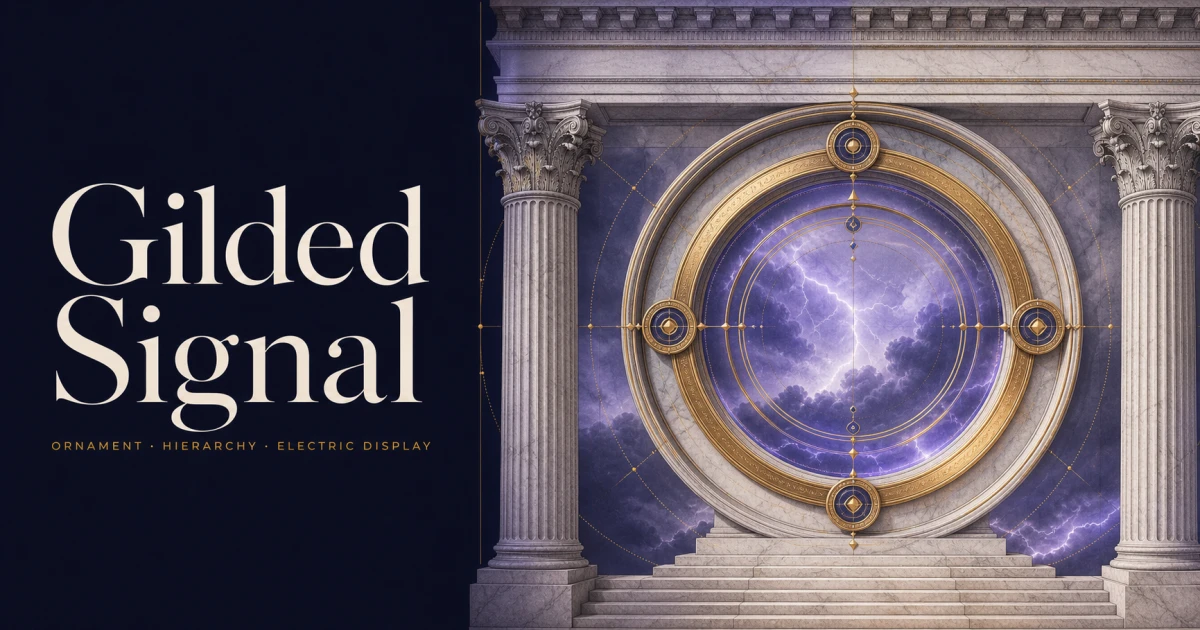
Gilded Signal studies how rings, seals, symbols, numbers, light and motion organise attention—calmly, historically and without rankings.
Featured articles
Six starting points for reading frames, symbols, hierarchy and motion.
The round frame has no privileged corner. That simple geometry makes it unusually effective at turning fragments into finished, centred events.
Read articleMonumental thresholds organise arrival, hierarchy and expectation. Screen frames borrow that logic even when no architecture is shown.
Read articleGold is a material, a colour family and a cultural signal. Editorial design improves when those three meanings are not treated as identical.
Read articleOversized numerals can be read before they are understood. That split between seeing and knowing is where responsible hierarchy begins.
Read articleThe bolt can signify weather, divine force, electricity, speed or danger. Context decides which reading arrives first.
Read articleSymmetry promises order, but equal placement does not guarantee equal meaning. Labels and consequences still require plain explanation.
Read articleSignature field guide
A non-ranked field guide to real visual traditions and objects. Each profile records public characteristics, one observation and an institutional trail.
Border system
Continuous right-angle path · modular repetition
A border can imply endless continuation while remaining built from one compact unit.
Open referenceArchitectural crown
Layered leaves · vertical rise · small corner volutes
Dense ornament concentrates at the transition between support and load.
Open referenceMonumental threshold
Central passage · flanking supports · emphatic crown
A threshold can stage arrival by separating approach from the framed field beyond.
Open referenceRadiant enclosure
Almond-shaped field · radiating edge · centred figure
The enclosure distinguishes a figure from ordinary pictorial space.
Open referenceInscription frame
Scroll edge · shield field · asymmetric flourish
A shaped border gives words the presence of an object.
Open referenceLight marker
Circular field · rays · high-contrast centre
Light becomes a boundary that marks status before a viewer reads any label.
Open referenceIdentity field
Shield outline · divided field · supporting devices
A compact silhouette can carry identity because its internal divisions are systematic.
Open referenceEnergy sign
Descending zigzag · acute point · diagonal force
The simplified branch becomes directional and can read as action even when it is decorative.
Open referenceSpatial instrument
Intersecting rings · shared centre · marked axes
Multiple circles can explain orientation when each ring has a distinct role.
Open referenceCommemorative object
Circular relief · inscription band · wreath or border
A portable object turns recognition into a framed, durable public statement.
Open referenceSystems anatomy
A teaching model distilled from the source image. The parts are analytical, not a recipe.
A calm background makes luminous edges legible.
The frame states what belongs together.
One focal point earns the strongest contrast.
Small diamonds and ticks describe position.
A diagonal introduces energy without motion.
Negative space gives spectacle somewhere to end.
Five-point manifesto
Observe before interpreting.
Name the history carried by a symbol.
Let hierarchy match factual importance.
Keep motion optional and nonessential.
Make new ornament; do not trace old art.
Latest articles
Methodology
Every attractive claim needs a traceable footing.
We describe public-facing geometry, material and placement before proposing meaning.
Museums, archives, standards bodies and scientific agencies establish the factual base.
Observation, design principle and current guidance receive distinct labels and sources.
Resemblance is not presented as influence, and approximate facts remain approximate.
Reader questions
It studies visual systems that appear in games and many other digital environments, but it does not review products, rank releases or advise on spending.
Interfaces borrow established forms—medals, shields, arches and halos. Historical context helps us see what those shapes imply before a label is read.
No. Profiles discuss public-facing characteristics and link to institutional records. Original diagrams and motifs transform general principles rather than tracing protected art.
We prefer static explanation, respect reduced-motion settings and consult current W3C guidance for motion and flash.
No paid or affiliate content appears in this prepublication edition. Any future commercial relationship must be disclosed at the start of the relevant page.
The institutional byline is Gilded Signal Editorial Desk. No individual staff biographies, credentials or fieldwork are claimed before verification.
Editorial transparency
This prepublication edition uses the institutional byline Gilded Signal Editorial Desk. It claims no named staff, credentials, field visits or private consultation. Generated visuals are labelled; sources and review dates are visible; corrections route to corrections@gildedsignal.org.